
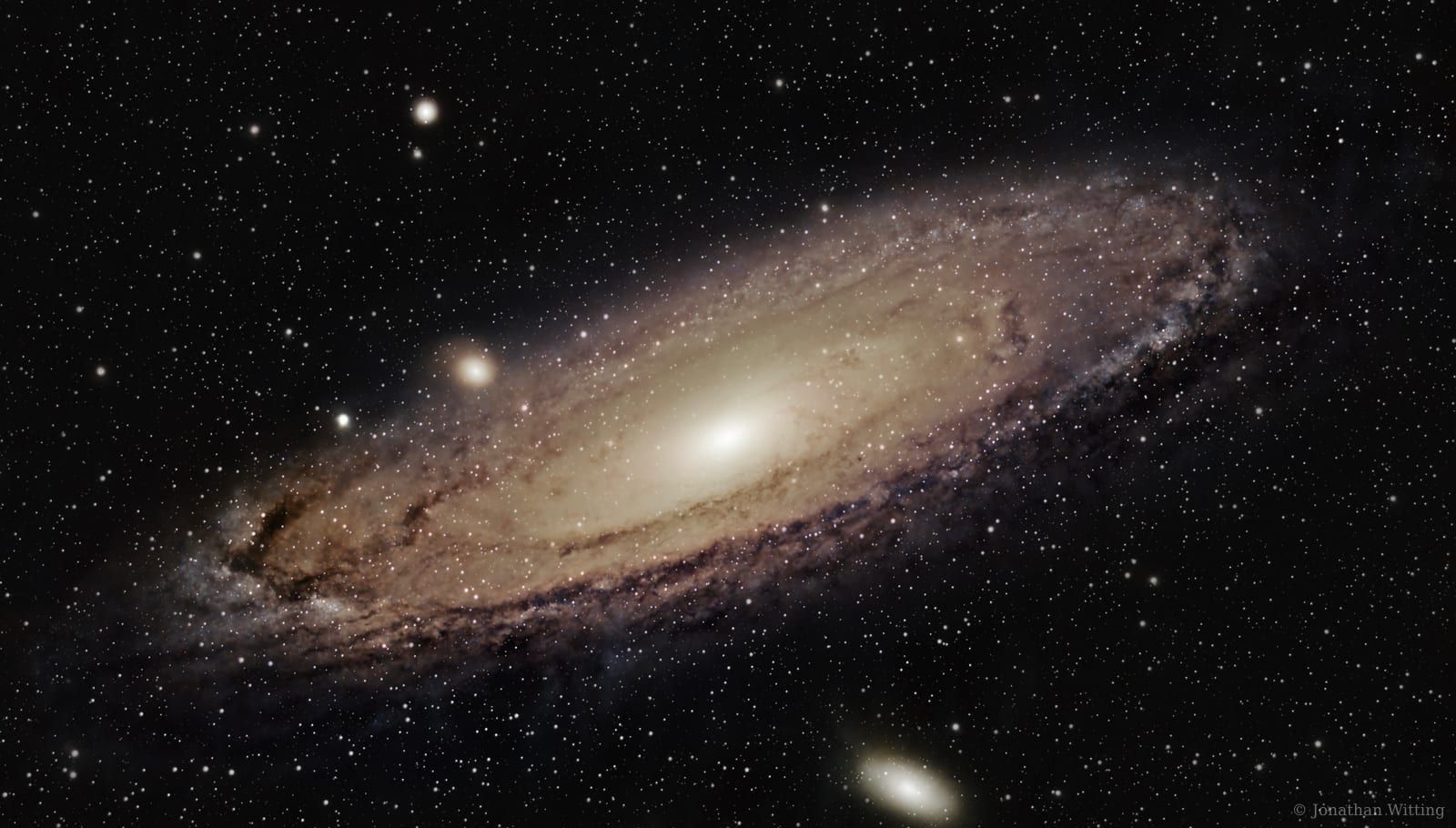
The Andromeda Galaxy needs little introduction. At around 2.5 million light years it's the nearest major galaxy to the Milky Way, a spiral somewhat larger than our own, and from a dark site its core is visible to the naked eye: the most distant thing most humans will ever see unaided.
For imagers, M31 presents an unusual problem. Most deep-sky targets are tiny; this one is enormous. The full disc spans roughly three degrees of sky, about six full moons laid end to end, which is bigger than most telescope fields of view. In the same frame you also get two companion galaxies for free: compact M32, tucked close against the disc, and the larger, more diffuse M110.
The essentials
| Designation | M31 / NGC 224 |
| Type | Spiral galaxy |
| Constellation | Andromeda |
| Distance | ≈ 2.5 million light years |
| Apparent size | ≈ 3° × 1° |
| Best season (UK) | September to January |
Why it's a great target
It's the one galaxy that behaves like a nebula: big, bright and forgiving. An evening of broadband data shows the disc, the dust lanes and both companions, and it climbs practically overhead from the UK in autumn. There's also no ceiling to it: every extra hour digs further into the faint outer disc, which extends well beyond where most images give up.
Capture notes
- Framing: at my 382mm focal length (f/5.9) the galaxy overflows a single frame; the outer disc runs off both ends however you rotate. I attempted a three-pane mosaic to capture the whole thing, which taught me a great deal and mostly the hard way: the full story is in A Tryptic Failure. A single well-rotated frame along the long axis still makes a fine image if mosaics aren't your idea of fun.
- Filters: broadband is the main course. My best single-frame dataset is 243 × 120s (8.1 hours) on the ASI 294MC Pro. A few hours of Hα is a worthwhile bonus layer, picking out the star-forming regions strung along the arms.
- Moon: shoot the broadband on moonless nights; the faint outer disc is the first casualty of moonlight.
- Exposure: the core is far brighter than the disc and blows out easily, so watch the histogram. Shorter subs, or a separate set of short subs blended in later, keep it under control.
Processing notes
The dynamic range is the whole battle. Stretch gently and repeatedly rather than in one heave, masking the core so it keeps its structure while the outer disc comes up. Colour calibration matters here too: a well-balanced M31 shows a warm yellow core grading into blue outer arms, threaded with brown dust lanes, and that gradient is what separates a good rendition from a grey smudge.