
One of my favourite deep space photos was taken by Hubble in 1995. It features the “Pillars of Creation” situated at the heart of M16, the Eagle nebula. In 2014 NASA decided to point Hubble at the Eagle nebula again, taking another image, more beautiful and detailed than the last. Fast forward again to 2022 and Hubble’s successor, the James Webb Space Telescope (JWST) locked its focus on the nebula. The resulting image it produced was sensational.
 Credits: NASA, ESA, CSA, STScI, Hubble Heritage Project (STScI, AURA); Joseph DePasquale (STScI), Anton M. Koekemoer (STScI), Alyssa Pagan (STScI).
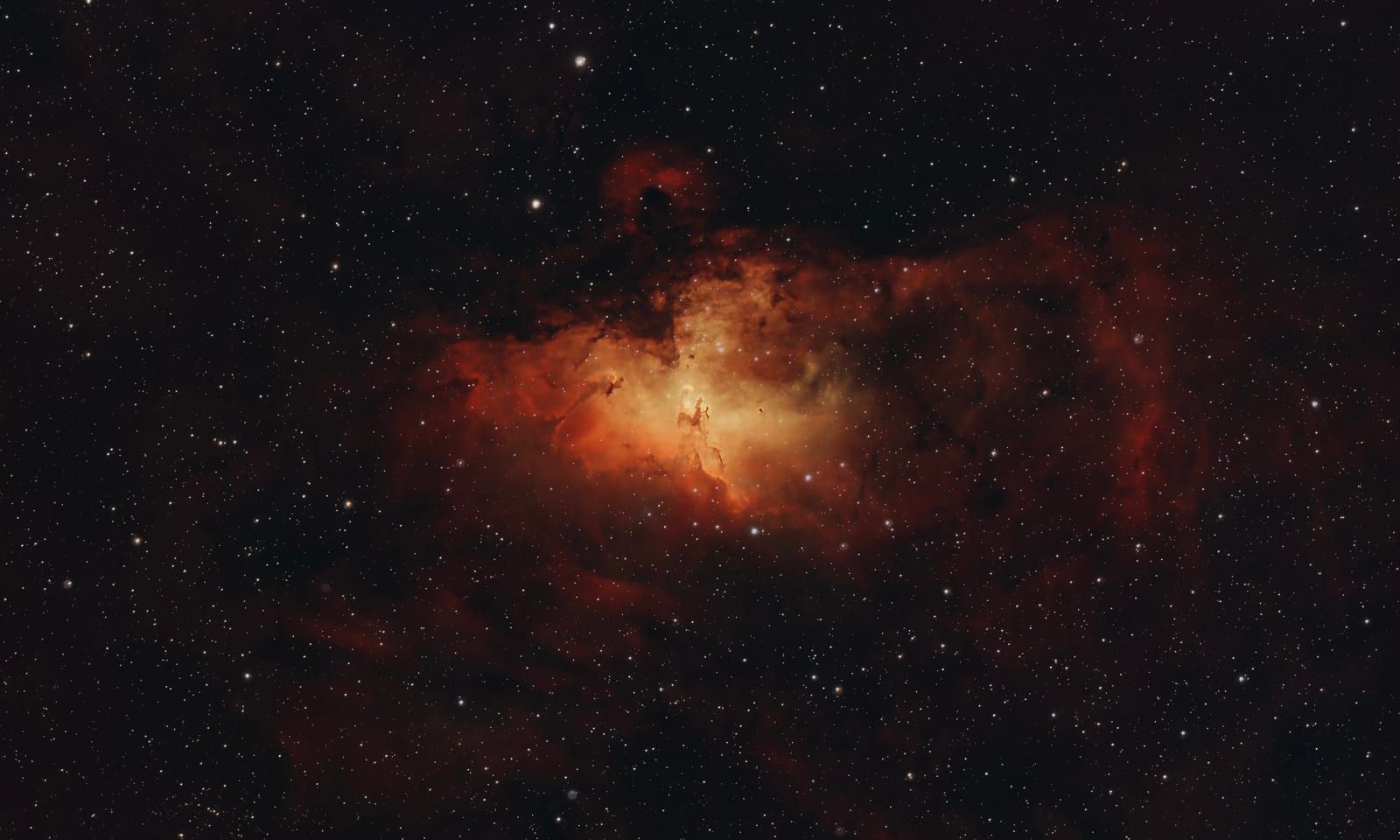
All three of these images have played a part in my fascination with the night sky. Initially as young boy when the first Hubble image was shared with the world and then subsequently reinvigorating my interest with each subsequent image. Now, as I’m embarking on my own astrophotography adventure it only seemed right to have a go at photographing the Eagle nebula for myself.
Obviously achieving something akin to the Hubble or JWST images is entirely impossible from a back garden and with a limited budget. Instead, my aim was simply to capture an image with the Pillars of Creation at the heart of nebula clearly visible.
In mid/late August M16 is visible to the south, however it doesn’t rise very high above the horizon. This provides a less than ideal angle for imaging but also a limited window in which to image before it’s obscured behind the treetops. With darkness arriving from around 9pm I figured that I could scrape together around 60 mins of data on the target. This doesn’t bode well for a high definition image, so I had to start planning imaging sessions on multiple nights to build up enough data.
I setup the gear early in the afternoon so that when darkness arrived I’d be able to get imaging as quickly as possible. It worked out nicely and I was able to slew the telescope over to the eagle nebula shortly after 9:30pm and commence imaging. After one night of successful imaging I left the scope out the following day as the weather was looking good for that evening too. The second night rolled around and polar aligning was a very quick job since the scope hadn’t moved. Shortly after 9pm I slewed the telescope over to the eagle nebula again and commenced imaging for a second time.

Following the second night, the weather started to look a little ropey for the coming days so I dismantled everything and took it back inside. After two nights of imaging, I gathered approximately 2.5 hours worth of data; enough to get started with processing and hopefully generate a reasonable image.
I carried out my usual process of spot checking the individual subs, removing any of poor quality or with obvious issues such as clouds or other obstacles blocking the image. After having done this I was only left with 1.5 hours of data on the target, really not as much as I’d like. With poor weather on the horizon for the coming week I knew that I’d have to make do with it though so I persevered.
Following a simple image processing sequence in PixInsight I was able to produce a rather pleasing image of the nebula considering the lack of data. I’d also managed to accomplish my goal of capturing the Pillars of Creation sitting at the heart in pretty good detail for an amateur setup.
In future I plan to revisit this target again, hopefully with more focal length, more exposure time and a mono camera instead of the one-shot colour camera I used this time. With this improved setup I should be able to get a more similar looking image to that of the colours in the Hubble and JWST images as well as the focal length helping bring out more detail at the heart of the nebula.
I'm under no illusions, I’ll never get close to the NASA images, however with practise and persistence I think I should be able to improve on my first attempt, just like Hubble did in 2014 compared with its first attempt in 1995.