
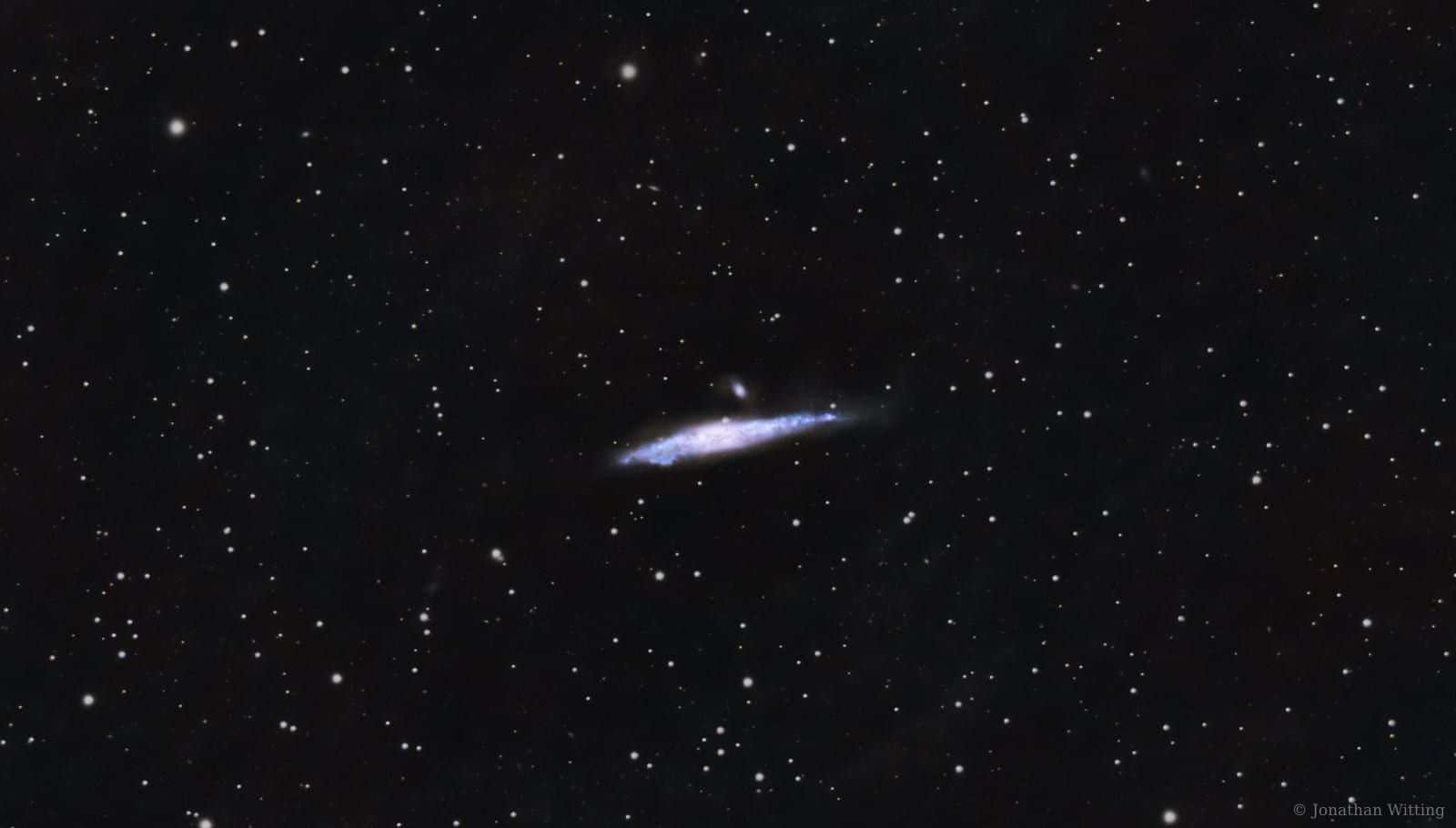
Not every galaxy obliges us with a tidy face-on view. The Whale Galaxy, NGC 4631, is a spiral roughly the size of our own Milky Way that we happen to see almost exactly edge-on, and the result is a long, slightly warped sliver of light that really does look like a whale mid-breach. The asymmetry isn't an accident: the galaxy is being tugged about by its neighbours, and its disc glows with knots of intense star formation, brightest around the swollen core.
It isn't alone. Perched just above the whale's back is NGC 4627, a small dwarf elliptical companion that completes the picture (some see a calf swimming with its parent). Half a degree away sits NGC 4656, the Hockey Stick Galaxy, another distorted edge-on spiral bent out of shape by the same gravitational tussle.
The essentials
| Designation | NGC 4631 |
| Type | Edge-on spiral galaxy |
| Constellation | Canes Venatici |
| Distance | ≈ 25 million light years |
| Apparent size | ≈ 15′ × 3′ |
| Best season (UK) | March to June |
Why it's a great target
Galaxy season can be frustrating with a small refractor, because most galaxies end up as small smudges in a wide field. The Whale earns its place because the field itself tells a story: a bright, textured edge-on spiral, a dwarf companion touching it, and the Hockey Stick close enough to share the frame. You're not imaging one object, you're imaging an interacting system. It also rides high in the UK spring sky, well clear of the murk near the horizon.
Capture notes
- Framing: at my 382mm focal length (f/5.9) the Whale and the Hockey Stick fit in a single frame with room to spare; frame the pair diagonally and the composition takes care of itself. Longer focal lengths trade the pairing for more detail in the whale's mottled disc.
- Filters: this is broadband territory. I shot mine unfiltered on the ASI 294MC Pro, 372 × 120s for 12.4 hours, and the integration time mattered far more than any filter would have. Galaxies reward patience.
- Moon: no narrowband safety net here, so save this one for moonless nights. A bright moon will wash out the faint outer disc faster than you'd think.
I wrote up the full session in Whale Watching if you want the night-by-night version, including why I let the sub count climb past 370. Short version: at 25 million light years, signal is scarce, and every extra hour showed up in the final stack.
Processing notes
Keep the stretch gentle around the core, which is much brighter than the disc, and use local contrast through a mask to bring out the dust mottling along the whale's flank. Background neutralisation matters more than usual too: with two galaxies and a lot of empty sky in frame, any gradient is immediately obvious.