
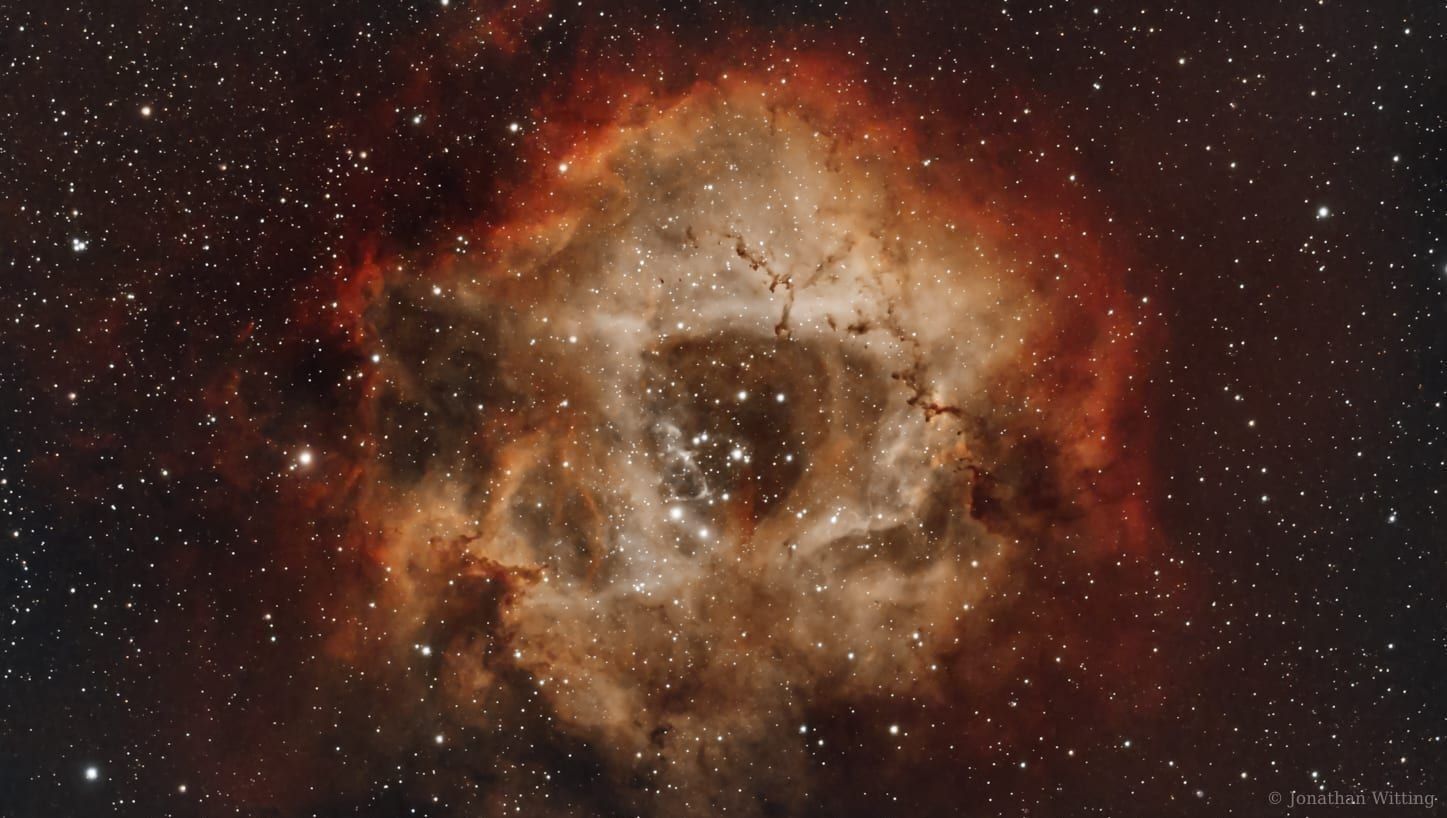
The Rosette Nebula is a colossal ring of glowing hydrogen at the end of a giant molecular cloud in Monoceros, around 5,200 light years away and roughly 65 light years across. At its centre sits the young open cluster NGC 2244, born from the nebula's own gas only a few million years ago. The cluster's hot stars are now hollowing out the middle of the cloud, carving the central cavity that gives the Rosette its flower-like shape.
On paper it's one object, but the catalogues carved it up long ago: the nebulosity carries the designations NGC 2237, 2238, 2239 and 2246, with NGC 2244 for the cluster. In the sky it spans well over a degree, comfortably larger than the full Moon, yet it's invisible to the naked eye. The camera is what brings it out.
The essentials
| Designation | NGC 2237-2239 / 2246 (cluster NGC 2244) |
| Type | Emission nebula with open cluster |
| Constellation | Monoceros |
| Distance | ≈ 5,200 light years |
| Apparent size | ≈ 1.3°, larger than the full Moon |
| Best season (UK) | December to March |
Why it's a great target
The Rosette pumps out hydrogen-alpha signal, and that makes it one of the most forgiving winter nebulae there is. A dual-band filter cuts through suburban light pollution and even moderate moonlight, and the structure starts appearing in the very first subs. There's plenty to reward longer integrations too: dark globules and elephant-trunk pillars silhouetted against the glow, and the subtle teal of OIII threading through the core.
The one drawback from the UK is altitude. Sitting near the celestial equator, the Rosette peaks at a modest height from southern England, so plan your session around its few best hours either side of the meridian.
Capture notes
- Framing: at 382mm the Rosette fills the frame beautifully, with the whole ring and a margin of the surrounding cloud. It's one of the targets my Zenithstar 81 feels made for; longer focal lengths have to settle for a section of the ring.
- Filters: a dual-band filter is the easy win here. I captured 73 × 300 second subs (just over 6 hours) with the Optolong L-eXtreme over two nights, and the hydrogen signal came through strongly despite the target's modest altitude.
- Moon: the strong Hα means the Rosette tolerates moonlight better than most. Save your darkest nights for broadband targets and let the Rosette soak up the rest.
Processing notes
A straightforward HOO-style rendering works well from dual-band data: red hydrogen shell, hints of blue-green towards the centre. The central cavity is where the detail lives, so a gentle local contrast boost there is worth doing. NGC 2244's stars are bright and will dominate if you let them; a star reduction pass, or processing the nebula starless and adding the stars back with restraint, keeps the rose as the subject rather than the cluster.