
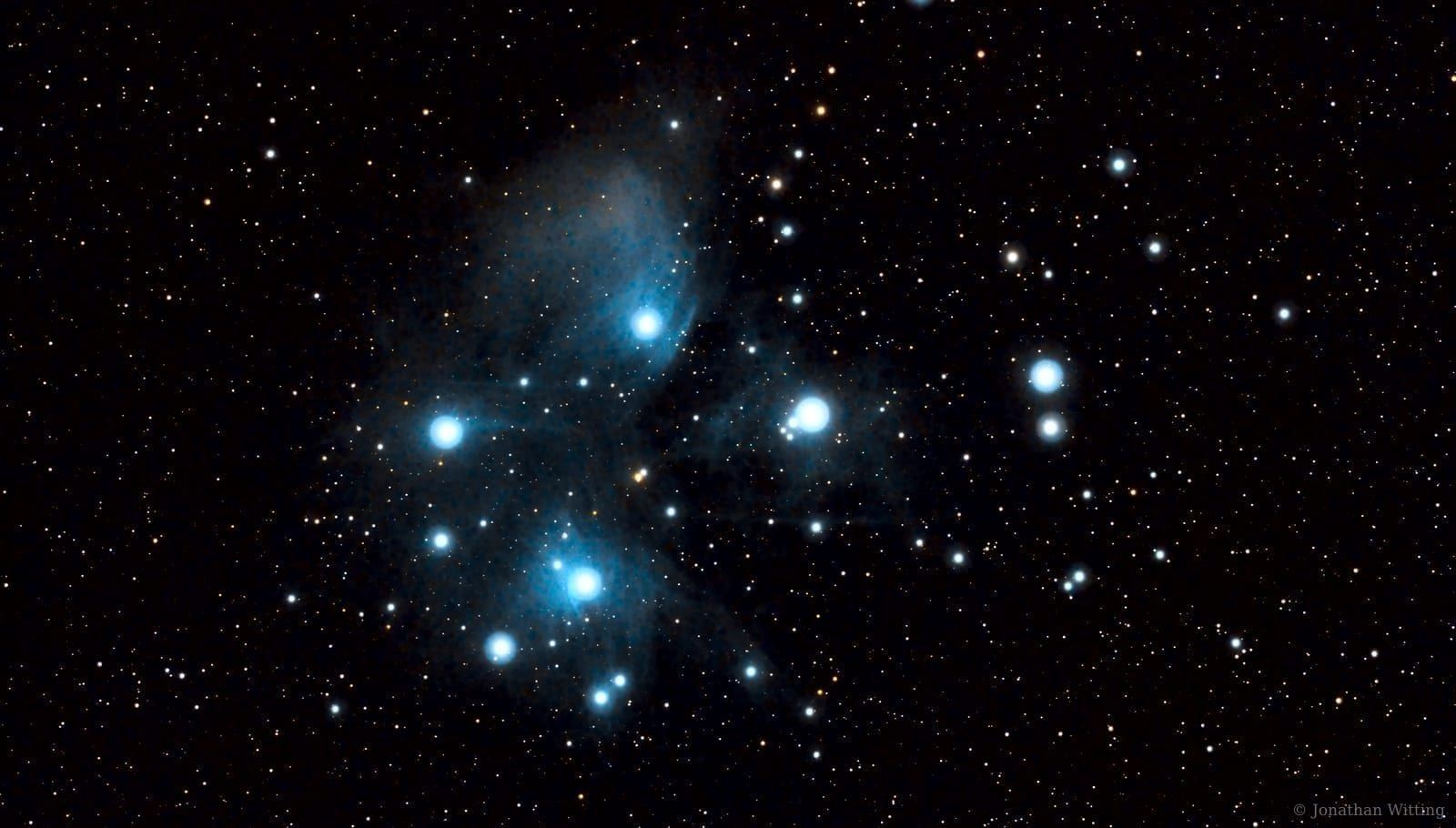
The Pleiades is the deep-sky object everyone has already seen. A compact knot of stars in Taurus, visible from any back garden, it has been catalogued, mythologised and navigated by for thousands of years. The cluster sits around 444 light years away and spans roughly 17.5 light years: a few hundred young, hot, blue stars that formed together around 100 million years ago.
The photogenic part is the blue haze wrapped around them. It's a common assumption that this is the cluster's birth cloud, but it isn't. The Pleiades left their nursery long ago and are currently drifting through an unrelated cloud of interstellar dust. The dust reflects and scatters the stars' blue light, which makes this a reflection nebula, and that one fact drives every capture decision.
The essentials
| Designation | M45 |
| Type | Open cluster with reflection nebulosity |
| Constellation | Taurus |
| Distance | ≈ 444 light years |
| Apparent size | ≈ 2° |
| Best season (UK) | October to March |
Why it's a great target
It's bright, it's high in the UK winter sky, and even a modest integration shows the nebulosity around the brightest stars. Go deeper and the field fills with faint, streaky dust running well beyond the cluster, with a texture like brushed silk. It also looks like nothing else in the catalogue: there's no red hydrogen here at all, just blues, silvers and the warm tones of foreground stars.
Capture notes
- Framing: at around two degrees, M45 fits my 382mm field with room to show the dust streaming off to the edges. Centre slightly off the brightest stars to balance the outlying nebulosity.
- Filters: none. Reflection nebulae shine by scattered starlight, a continuous spectrum, so narrowband and dual-band filters simply throw the signal away. When I shot my 58 × 180 second subs (about 2.9 hours) the L-eXtreme was still in my imaging train from a previous emission target, exactly the wrong filter for this object. It still produced an image I was happy with, but next time I'd shoot it unfiltered and go deeper on the dust.
- Moon: because you can't filter your way out of trouble, dark and moonless skies matter far more here than for any emission nebula. Save your best new-moon nights for this one.
Processing notes
The whole challenge is teasing out wispy dust without bloating the stars, because the stars are hundreds of times brighter than the nebulosity around them. Stretch through a star mask, or remove the stars before stretching and recombine them with a much gentler curve. Keep the colour natural too: the nebulosity should be a cool blue, not electric cyan, and the faint outer dust is nearly grey. If your background is mottled, more integration beats more aggressive noise reduction every time.