
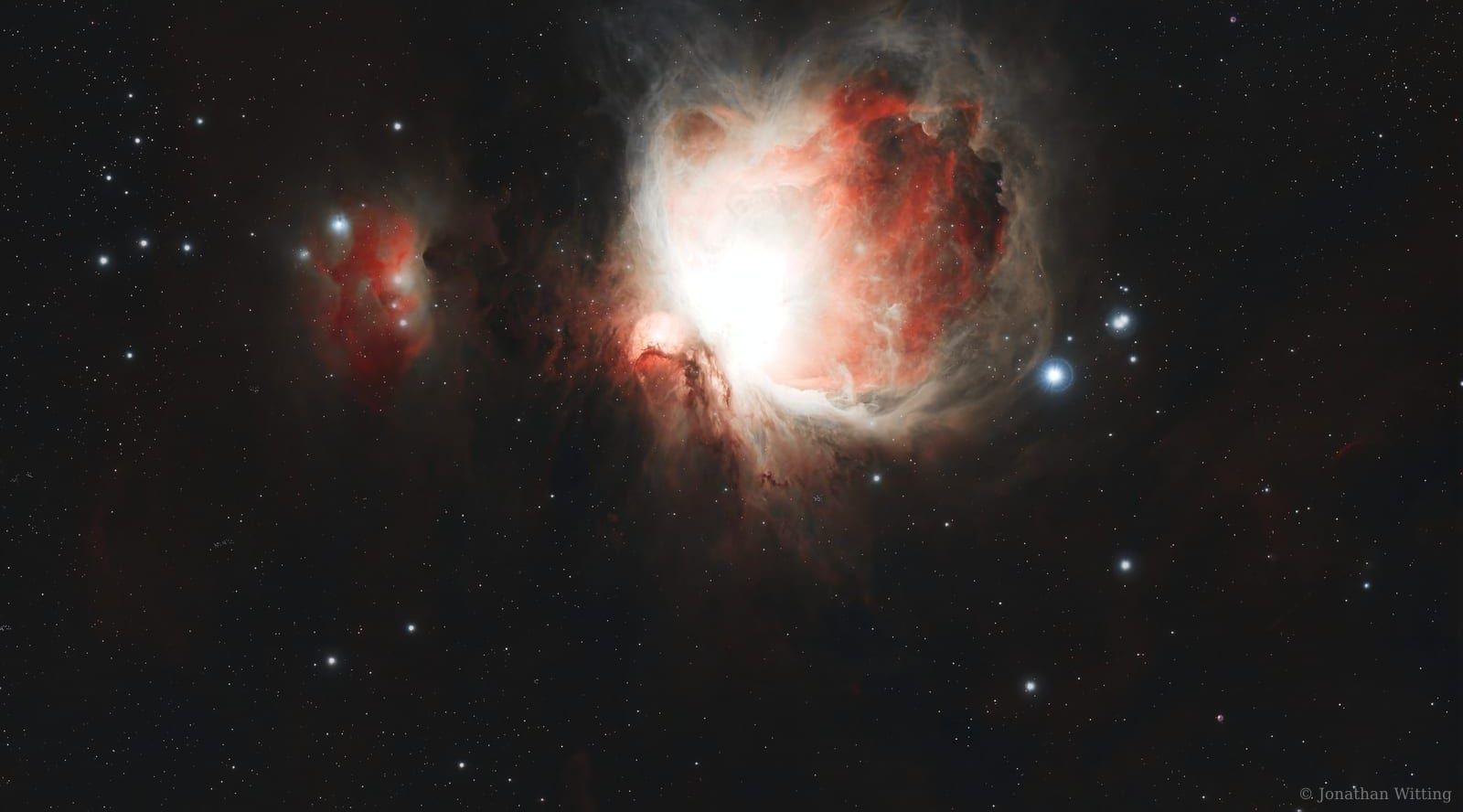
M42 is the showpiece. The brightest nebula in the northern sky, visible to the naked eye as the fuzzy middle "star" of Orion's sword, and close enough at around 1,300 light years that we get a grandstand view of a stellar nursery in action. At its heart sit the four hot young stars of the Trapezium, carving out and illuminating the cavern of gas around them.
It doesn't come alone. Tucked against it is M43, a smaller round nebula split off by a dark lane, and just to the north is the Running Man Nebula, a patch of blue reflection nebulosity that completes one of the best wide-field compositions in the sky.
The essentials
| Designation | M42 (NGC 1976), with M43 and the Running Man nearby |
| Type | Emission nebula (star-forming region) |
| Constellation | Orion |
| Distance | ≈ 1,300 light years |
| Apparent size | ≈ 85′ × 60′ |
| Best season (UK) | November to February |
Why it's a great target
It is astonishingly forgiving in one sense: thirty seconds of exposure shows obvious nebulosity, so even a first-night-out attempt produces something. But it hides a genuine technical challenge, because the brightness range from the Trapezium core to the faint outer wings is enormous. A single exposure length cannot hold both, so this is the target that teaches you high dynamic range technique.
Capturing it properly had been a goal of mine since I started the hobby, and the geography didn't help: from my garden M42 is only visible for a narrow 3 to 5 hour window each night. I shot it over two nights with the ASI 294MC Pro and L-eXtreme, mixing exposures deliberately: 53 × 180s for the faint outskirts, 11 × 120s, and 182 × 60s to keep the Trapezium core from blowing out, about 6.1 hours in total. It remains one of the images I'm proudest of, and the full session is in my Orion Nebula write-up.
Capture notes
- Framing: at my 382mm field there's room for M42, M43 and the Running Man together with space around them. Place the sword axis on the diagonal and the composition largely takes care of itself.
- Exposures: shoot at least two lengths, ideally three. Long subs (180s) for the faint wings, short subs (30 to 60s) for the core. Don't skimp on the short set; you need enough of them to stack cleanly.
- Filters: it's bright enough to shoot broadband even from town, which keeps the lovely teal and pink colour balance. A dual-band filter works too but skews the palette red.
- Moon: it tolerates some moonlight better than most, but the Running Man's blue reflection signal fades fast under it.
Processing notes
Blend the exposure sets into an HDR composite before stretching, either with dedicated HDR integration or masked combinations. The goal: Trapezium stars resolved as four points inside an unburnt core, with the outer wings still rising out of the background. Stretch gently and repeatedly rather than in one heave, and keep saturation in hand; M42 needs no encouragement to be colourful.