
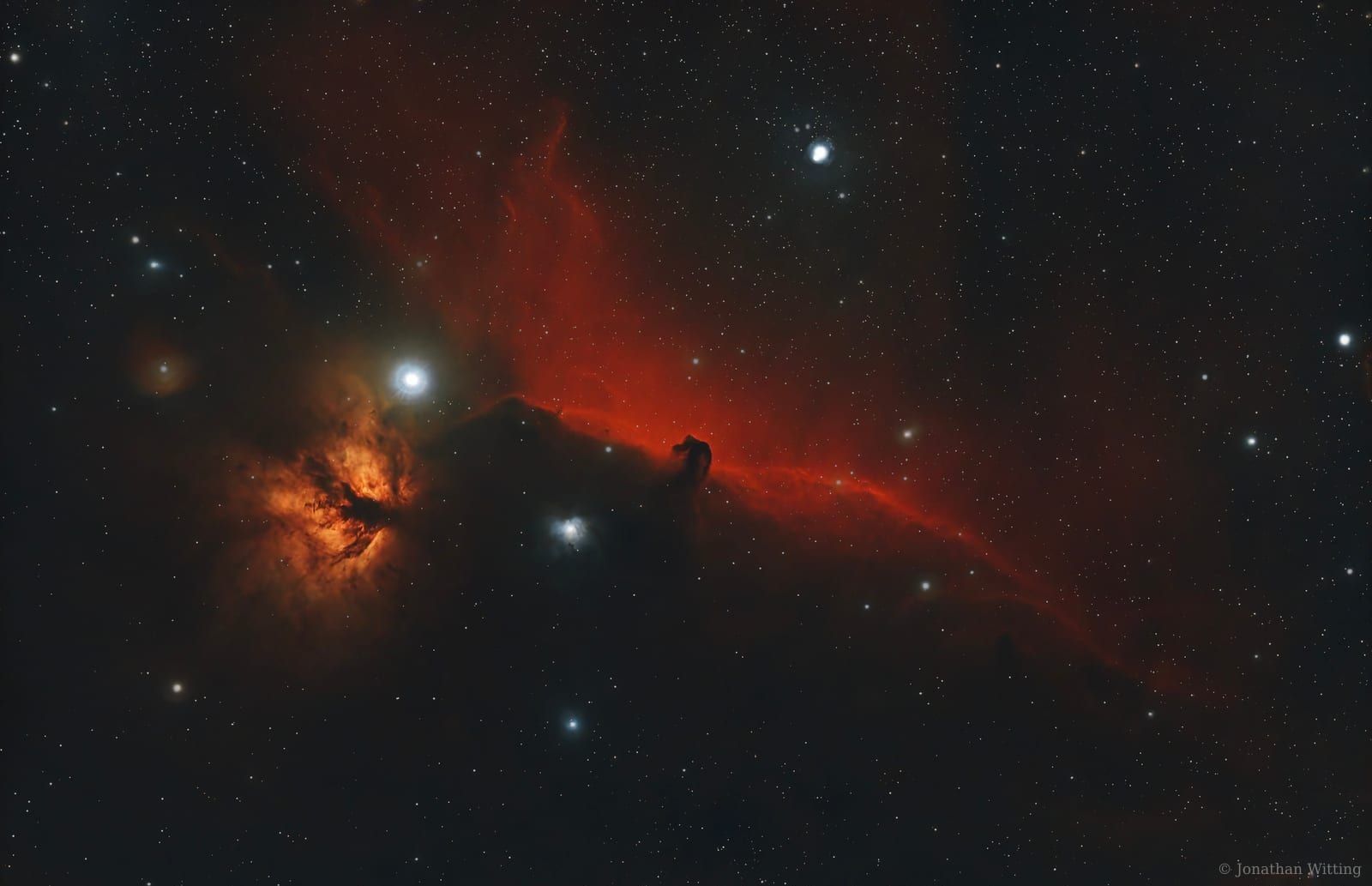
The Horsehead is probably the most recognisable shape in the deep sky, and it's a trick of contrast. The horse's head itself, catalogued as Barnard 33, is a cold, opaque pillar of dust. It only stands out because it happens to sit in front of IC 434, a glowing curtain of hydrogen lit up by the nearby star system Sigma Orionis. No backlight, no horse.
It comes with excellent neighbours too. Just to the east, beside the bright belt star Alnitak, sits the Flame Nebula (NGC 2024), with its distinctive orange glow and dark central lanes. The whole region is around 1,400 light years away in Orion, part of the same vast molecular cloud that gives us M42.
The essentials
| Designation | Barnard 33 (against IC 434) |
| Type | Dark nebula against an emission nebula |
| Constellation | Orion |
| Distance | ≈ 1,400 light years |
| Apparent size | ≈ 8′ × 6′ (the Horsehead itself); IC 434 ≈ 1° long |
| Best season (UK) | December to February |
Why it's a great target
Few targets give you this much variety in one frame: a dark nebula, an emission curtain, the Flame, blazing Alnitak and (with a wider crop) wisps of blue reflection nebulosity. It's an image with several stories in it, and the Horsehead shape needs no explaining to anyone you show it to.
Be realistic about the difficulty from the UK, though. Orion's belt sits at declination roughly minus two degrees, so the target never climbs much above 35 degrees from southeast England, and the winter window is short. I caught mine in a single, partially cloudy night of 180s subs with the Optolong L-eXtreme on my ASI 294MC Pro, and the result came out a little washed out and hazy for it. I'm glad I got it, but it's firmly on my revisit list with more hours and better conditions. The full story is in my Horsehead session write-up.
Capture notes
- Framing: at my 382mm field the Horsehead and Flame frame together beautifully, with IC 434 running through the frame and Alnitak between the two. Decide early whether Alnitak sits in frame or just outside; its glare dominates either way.
- Filters: IC 434 is almost pure hydrogen-alpha, so an Ha or dual-band filter is a big help under light pollution. The Flame is partly a broadband object, so don't expect the filter to flatter it equally.
- Moon and altitude: the low altitude means you're already fighting murk; add a bright moon and it's not worth setting up. Plan for the two or three hours around transit and accumulate over several nights.
Processing notes
Alnitak is the battle. Stretch carefully with the star masked or removed, or its halo will swallow the Flame. Keep the contrast boundary between B33 and IC 434 crisp; oversharpening here looks artificial fast. And resist over-stretching thin data: as I found, a hazy night shows up mercilessly in the final image, and more integration beats more processing every time.