
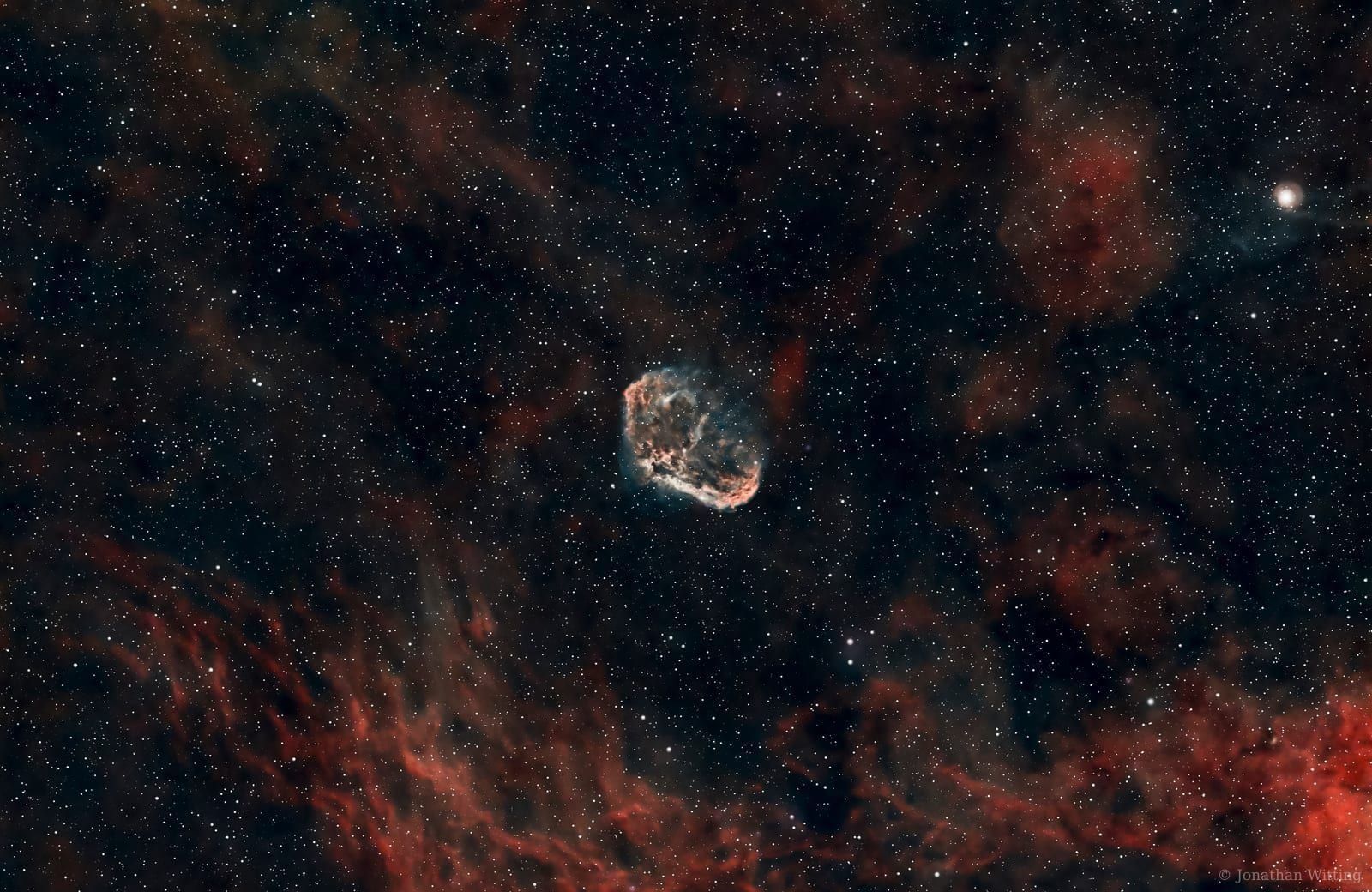
The Crescent Nebula is a star turning itself inside out. At its centre sits WR 136, a Wolf-Rayet star: a massive sun in the final act of its life, shedding material at a ferocious rate. A few hundred thousand years ago, as a red supergiant, it puffed off its outer layers in a slow, dense envelope. Now its exposed core drives a far faster stellar wind that is ploughing into that older shell from the inside, sweeping it up and shock-heating it until it glows. The result is a rumpled bubble around 25 light years across, and a temporary one: WR 136 will likely end as a supernova, erasing the Crescent entirely.
It sits deep in the Cygnus Milky Way, embedded in a backdrop of faint hydrogen that fills the whole frame.
The essentials
| Designation | NGC 6888 |
| Type | Wolf-Rayet shell (emission nebula) |
| Constellation | Cygnus |
| Distance | ≈ 5,000 light years |
| Apparent size | ≈ 18′ × 12′ |
| Best season (UK) | June to October |
Why it's a great target
For UK imagers the Crescent arrives with the summer and passes nearly overhead, so you're shooting it through the least atmosphere possible during the warmest nights of the year. It's a proper two-line narrowband object as well: the shell is bright in hydrogen-alpha, while a softer, fragile-looking skin of OIII wraps around the outside. Capturing that blue-green envelope is the real prize. The short summer nights never get fully dark from southern England, but narrowband filters take most of the sting out of that.
Capture notes
- Framing: at my 382mm focal length (f/5.9) the Crescent is on the small side, sitting in a wide field of glowing Cygnus background, so treat the surrounding hydrogen as part of the composition rather than empty space. The very faint Soap Bubble Nebula hides in the same field if your data goes deep enough.
- Filters: dual-band is the way in with a colour camera. I captured mine with the Optolong L-eXtreme on the ASI 294MC Pro: 150 × 180s at unity gain, 7.5 hours over two nights, and the write-up is at Photographing NGC 6888, the Crescent Nebula.
- Moon: Hα tolerates moonlight, but the outer OIII envelope is faint and fragile, so give this target your darkest nights if you want the full shell.
Processing notes
An HOO palette suits the Crescent well: a red-gold shell wrapped in a blue OIII skin. The star field here is about as dense as the sky gets, so star removal before stretching is close to mandatory; the nebula reads completely differently once the stars are out of the way. Stretch the OIII layer carefully, as it sits barely above the background, and resist the urge to clip the faint Hα backdrop to black. That glow is real, and it gives the bubble some context.