
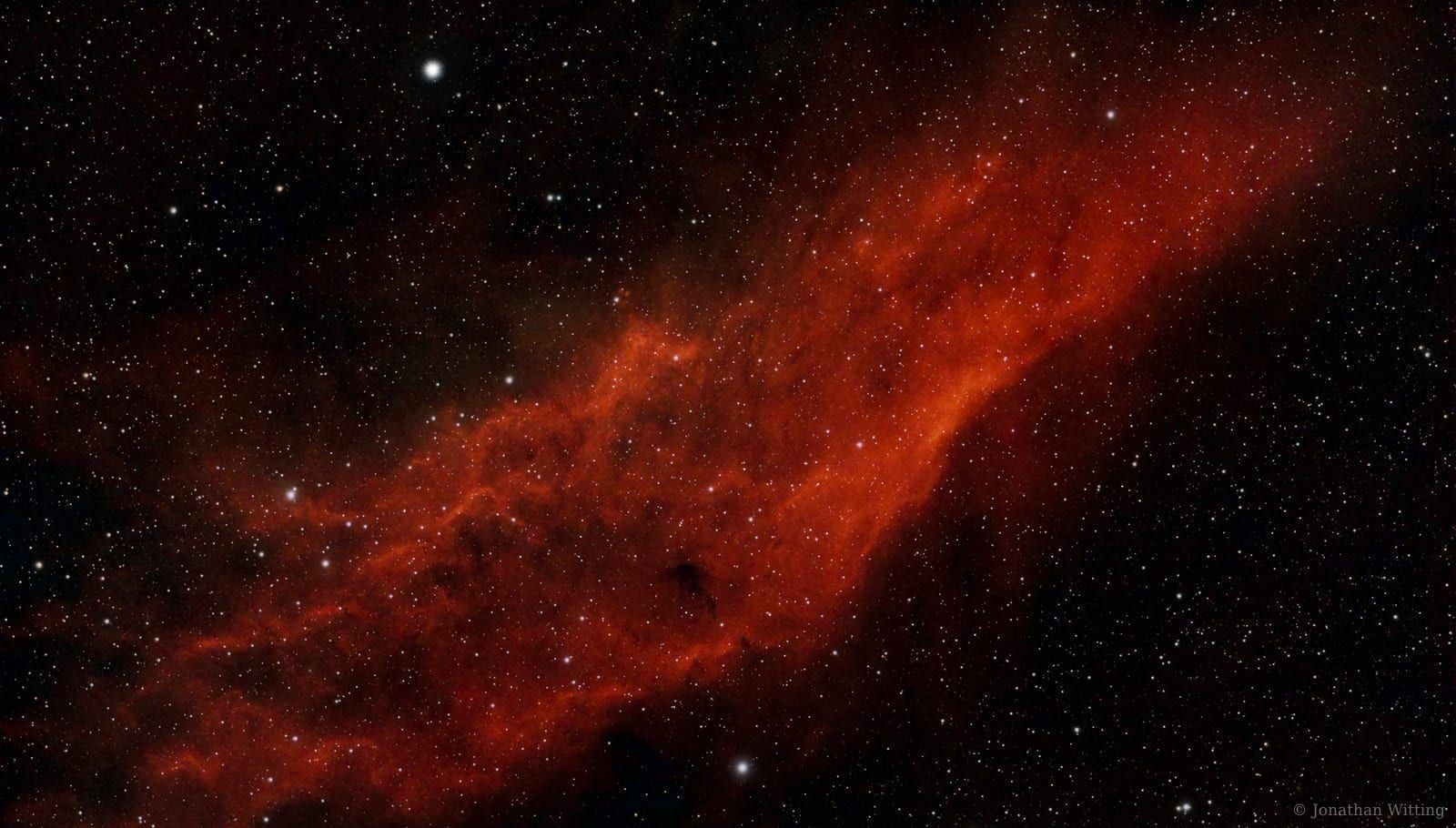
Squint at the outline of NGC 1499 and you'll see how it got its name. It really is a startlingly good match for the coastline of California: a huge, lazy ribbon of hydrogen stretching some two and a half degrees across Perseus, five full moons laid end to end.
The nebula glows because of one star: Menkib (Xi Persei), the bright blue star just south of it. Menkib is an O-type runaway star, one of the hottest naked-eye stars in the sky, and its ultraviolet radiation is enough to set this entire cloud of hydrogen fluorescing from a considerable distance.
The essentials
| Designation | NGC 1499 |
| Type | Emission nebula |
| Constellation | Perseus |
| Distance | ≈ 1,000 light years |
| Apparent size | ≈ 2.5° × 0.7° |
| Best season (UK) | October to February |
Why it's a great target
Three reasons this belongs near the top of an autumn imaging list:
- It rides high. From the UK it passes close to the zenith, so you're shooting through the least possible atmosphere. The exact opposite of a target like M16.
- It suits modest kit. At 2.5 degrees long it needs a short focal length: a small refractor in the 250 to 450mm range, or even a camera lens, frames it perfectly. This is one target where the most affordable setups have the advantage.
- It's available all night, for months. No frantic meridian-window maths. Integrate at your leisure across the whole winter.
Capture notes
- Framing: run the long axis diagonally across the frame and leave room for Menkib below. The star is part of the story and anchors the composition.
- Filters: this is an almost pure hydrogen-alpha object. From light pollution, an Hα or dual-band filter transforms the result. The OIII signal is faint, so don't expect Veil-style two-tone colour.
- Patience: surface brightness is low even though the total brightness is high. Think in multiples of hours, not minutes. The texture along the bright rim is what longer integration buys you.
Processing notes
The challenge is colour: shot in broadband or dual-band the nebula renders almost uniformly red, so the interest has to come from structure. Emphasise the bright ionisation front along the northern edge and the cursive dark lanes within the body. A careful star reduction helps too. Perseus is a busy star field and the nebula reads far more clearly once the stars step back.