
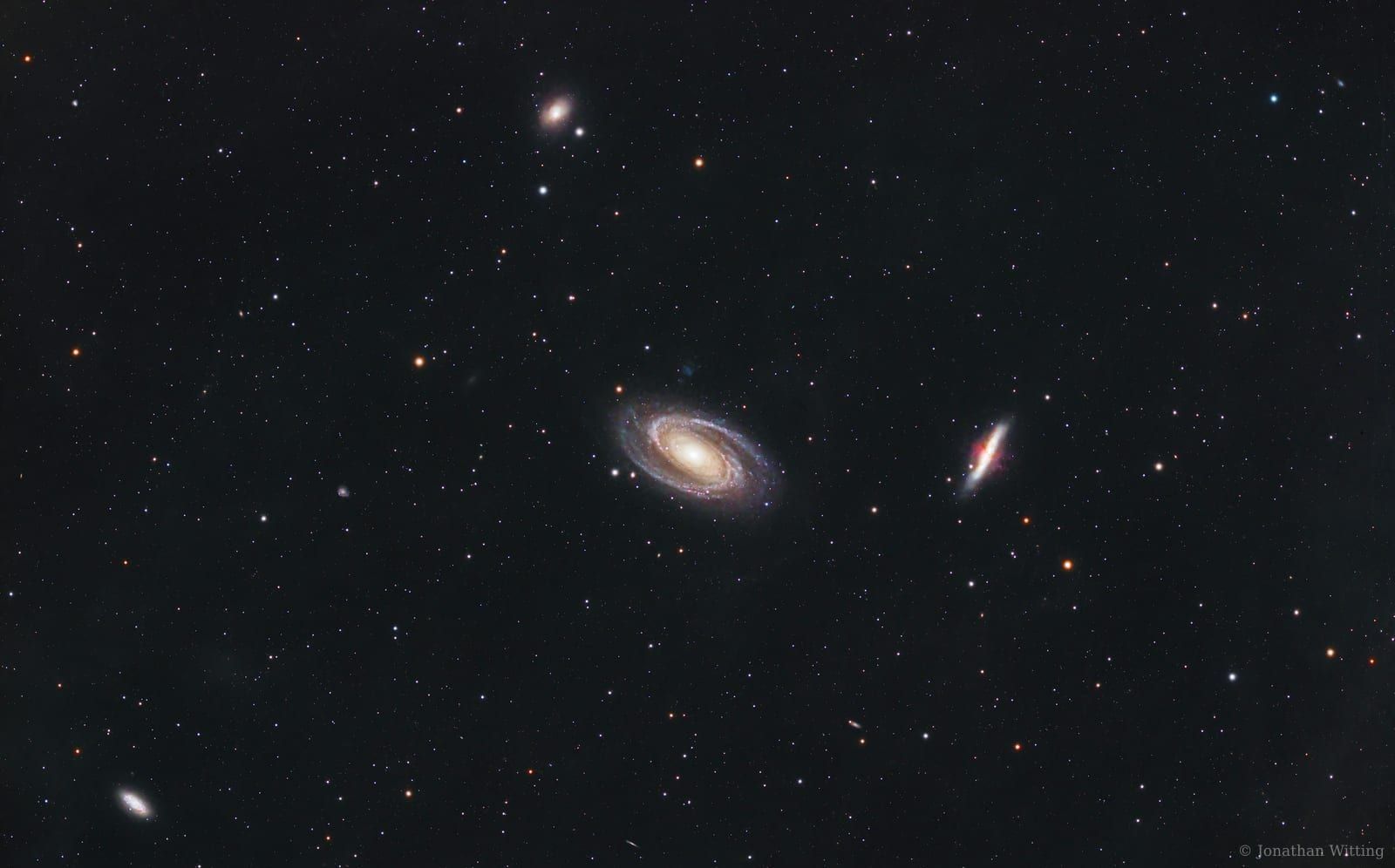
M81 is one of the brightest galaxies in the northern sky and arguably the best beginner galaxy for UK imagers. It's a near-perfect spiral seen at a gentle tilt, around 12 million light years away in Ursa Major, and it never sets from British latitudes, so you can find it on any clear night of the year.
The real selling point, though, is the company it keeps. Barely half a degree away sits M82, the Cigar Galaxy, an edge-on starburst galaxy being actively stirred up by its big neighbour. Two completely different galaxies, one calm and classical, one ragged and violent, in a single field of view.
The essentials
| Designation | M81 (NGC 3031), with M82 nearby |
| Type | Spiral galaxy |
| Constellation | Ursa Major |
| Distance | ≈ 12 million light years |
| Apparent size | ≈ 27′ × 14′ |
| Best season (UK) | January to May |
Why it's a great target
Most galaxies punish short focal lengths. This pair rewards them. At a few hundred millimetres you can frame M81 and M82 together with room to breathe, which turns a "small fuzzy blob" problem into a strong composition. M81 is also bright enough that structure appears quickly: the core and inner arms show up within the first hour.
It's a target I've grown up with, in imaging terms. My first attempt was in 2021 with an old DSLR, one of my first nights out with the rig, and I managed just 14 × 180s before cloud rolled in. In 2024 it was my choice for first light with the ASI 2600MM Pro: LRGB at 25, 24, 25 and 25 × 180s respectively, about five hours, and easily my best capture of it. I wrote that session up in my ASI 2600MM Pro first light review.
Capture notes
- Framing: at my 382mm focal length the pair fits comfortably with both galaxies well clear of the frame edges. Put the line between them roughly on the diagonal and they balance each other nicely.
- Filters: broadband LRGB or one-shot colour. If you shoot mono, a few hours of Ha is a lovely extra for M82, whose hydrogen outflows erupt perpendicular to the disc.
- Moon: as with all broadband galaxy work, moonlight washes out the faint outer arms. Keep this one for dark nights.
Processing notes
The two galaxies want different treatment. M81's challenge is dynamic range: protect the bright core while stretching the faint, blue outer arms. M82's is sharpness and colour, with that distinctive cigar shape and the reddish central turmoil. Process the stretch for the faintest parts of M81 and then rein the cores back in with masked curves. There's also very faint galactic cirrus (the Integrated Flux Nebula) across this whole region; with a long integration and a dark sky, be careful not to flatten it away as "gradient".