
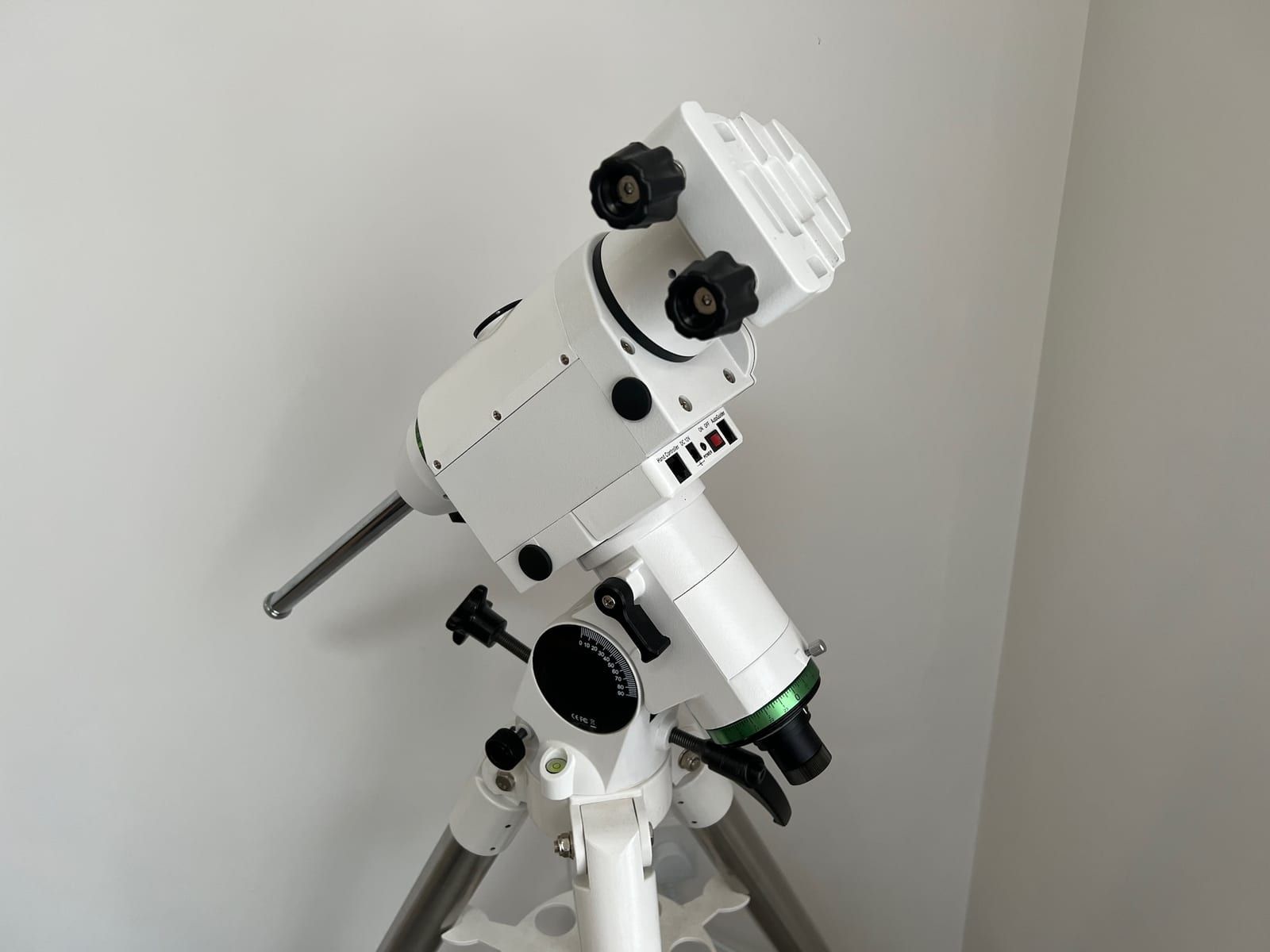
To start, it's worth clarifying what a “mount” is. Essentially, it's a tripod (or equivalent) that acts as a stable base for a telescope to sit atop. In general, the more stable the telescope is on a mount, the better your images have the potential to be.
There really aren't that many variations of mounts that you can use for astronomy and in practice there are only 2 types that are used the majority of the time:
- Altazimuth
- Equatorial (& German variation)
Beyond these 2 common choices there are others such as Dobsonian turntables which I'm not going to cover in this post, since they're not really favoured for astrophotography and I have limited knowledge on them.
Altazimuth
Altazimuth mounts have 2 axes of motion. Horizontal (azimuth) and vertical (altitude). This is also where the abbreviated name of “alt-az” comes from for these mounts.
Centering a target using this type of mount is a matter of adjusting both axes of motion to find the right balance. Once centred, the object will slowly drift out of view as the night sky moves relative to our position on Earth. Minor corrections in both axes are required to keep it in shot throughout the night. This can be tricky for precisely centering a target over long durations, however many versions of the mount now include motors to help automate the adjustments required.
Alt-az mounts are ideal for observing nearer to Earth objects such as the Moon, nearby stars and depending on the focal length of the telescope mounted, some of the closer planets. Going any further than this, trying to view deep space objects and you'll likely run into some difficulties with precision tracking. Although these mounts can track smoothly across the night sky, they're not designed in an optimal way to maintain precise guiding for long durations.
Equatorial (& German variation)
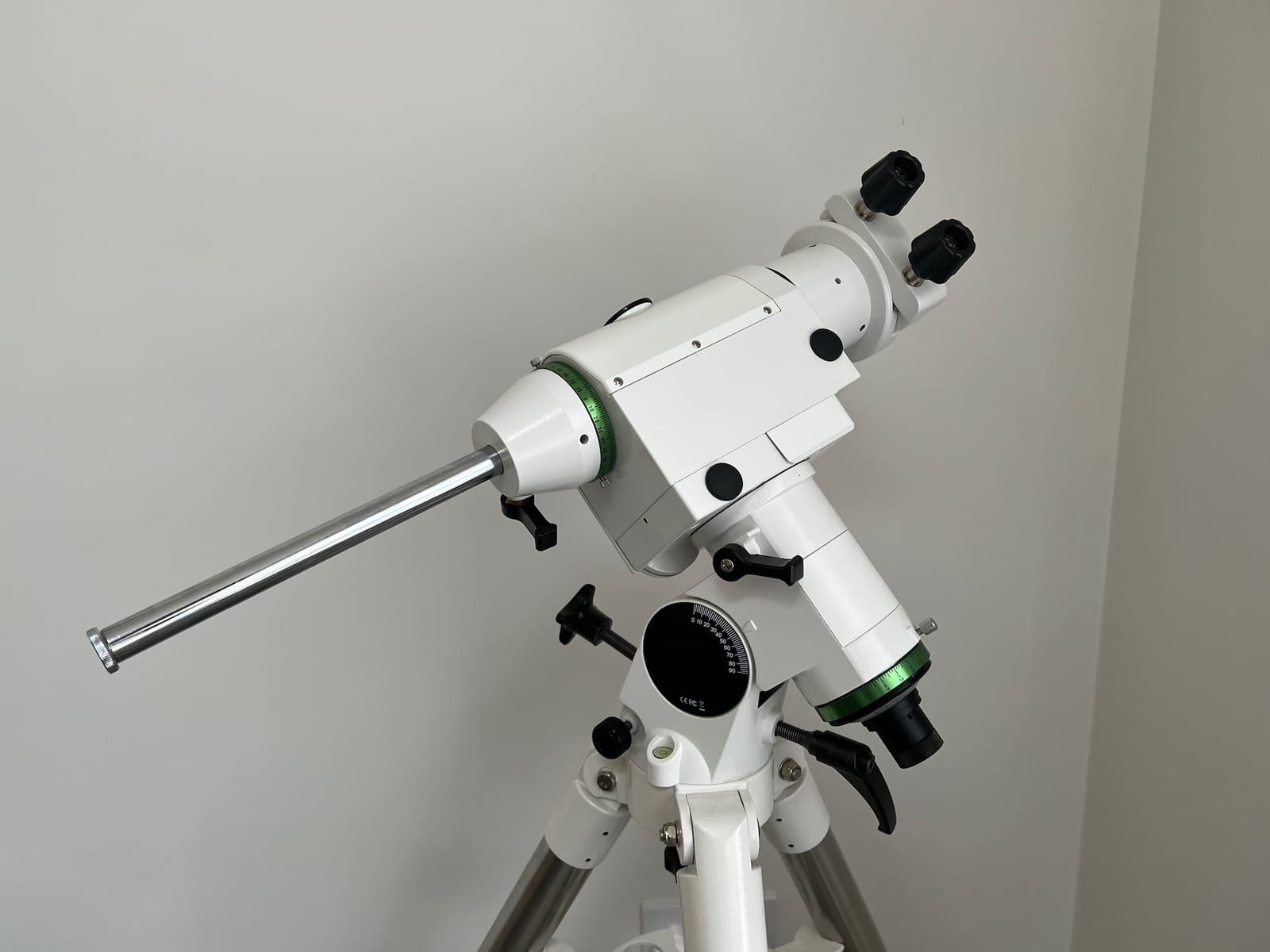
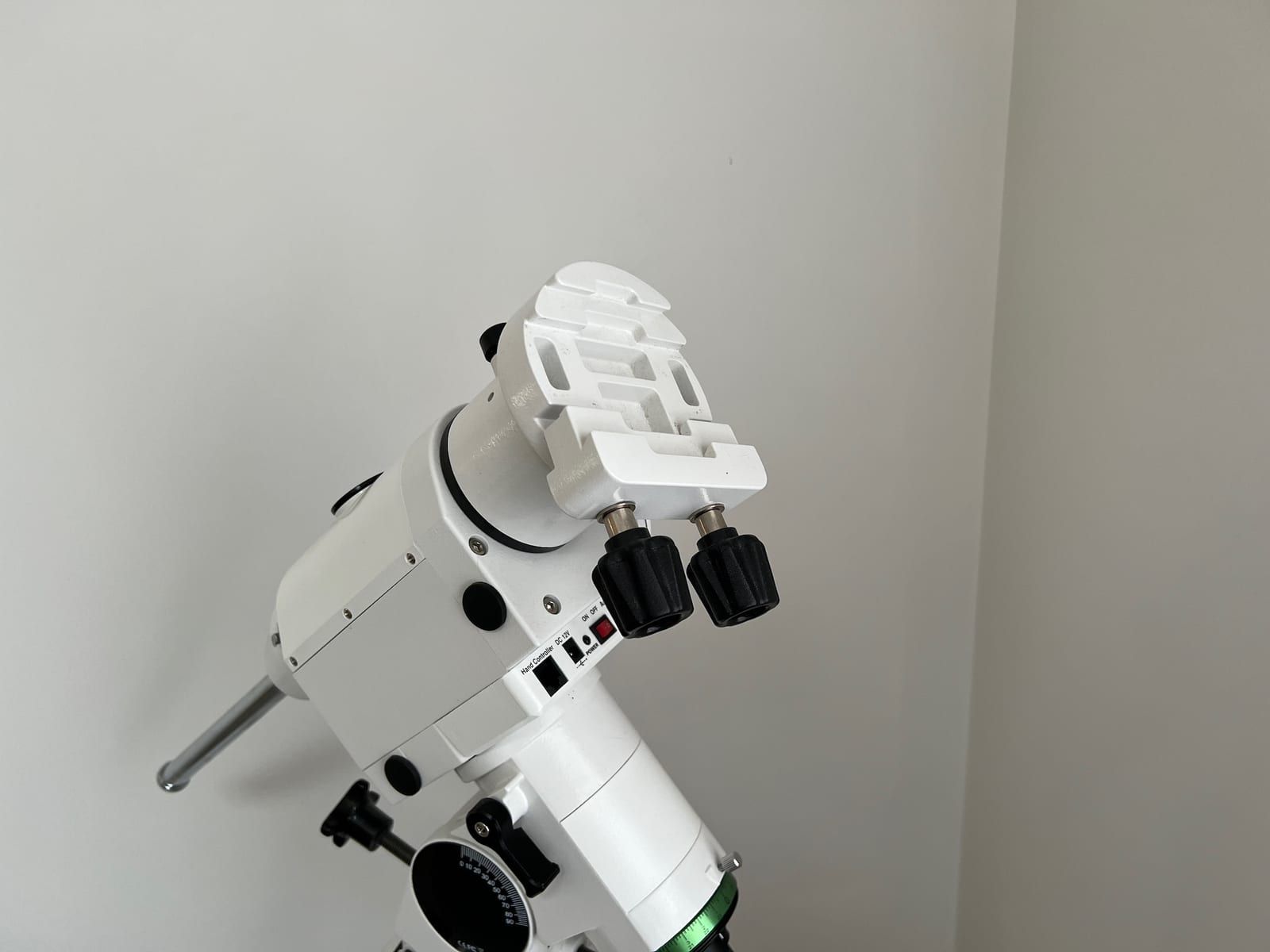
Equatorial mounts on the other hand have 3 axes of motion. Vertical (altitude), equatorial (right ascension or RA for short) and declination which is perpendicular to the equatorial/RA axis.
The image below shows the mount rotated on its RA axis.
Similarly, the following image shows the mount rotates in its dec axis (it the top of the mount has been twisted round).
For the altitude axis you can refer to the first image which shows two bolts at the top of the tripod and the base of the mount. Moving these handles/bolts tilts the mount upwards or downwards as required.
They're designed to minimise the number of adjustments required throughout the night; more specifically, a correctly aligned equatorial mount should be able to accurately track an object with just a constant, steady adjustment to the RA axis. Dec and latitude and be left alone for the most-part.
How does that work? As the Earth rotates on its axis, the night sky appears to move in the opposing direction at the same rate. Track this motion of the night sky for a prolonged period and you'll see that it's not happening in a perfectly straight line, but is arced. This is often photographed in its own right and is referred to as star trails.
The reason it happens is because everything you're seeing in the sky is rotating around one of two points depended on your location; the north celestial pole (NCP) if you're in the northern hemisphere and the south celestial pole (SCP) when in the Southern Hemisphere. If you wait long enough and track the same object in the sky, it will naturally return to where it started (or there about) after 24 hours (I.e. a full rotation of the earth).
Equatorial mounts aim to capitalise on this motion and are designed to position the mounted telescope in such a way that the can follow that arc by only adjusting the RA axis.
For this reason, these types of mounts must be calibrated each time before they're used. This means performing a polar alignment first, then centring a chosen target and finally making those constant adjustments to RA to keep the target centred. Doing this properly and precisely can lead to very accurate guiding, which is ideal for long exposure astrophotography. It's further simplified as the overwhelming majority of mounts have the RA motor built in or available as an attachment that can be added.
Oh, and a final note on the German variation vs. the regular; the only material difference relates to how effectively you can balance a telescope on the mount. The German equatorial mount has a bar that counterweights can be added to which sits underneath the telescope (I.e. along the declination axis). The regular version of the mount doesn't have this feature.